How to brief a bilingual copywriter: a practical guide for international teams
A good brief is the most efficient investment you can make in a copywriting project.
Here is how it usually goes wrong:
An international marketing team spends weeks preparing the strategy for a Spanish market launch. They have the product, the audience, the budget. They send a brief to the copywriter that says, essentially: we need this translated into Spanish and adapted for the market. Here is the English copy.
Six weeks and two revision rounds later, the copy still doesn’t feel right. The tone is off. Key messages are buried. The team is frustrated, the copywriter is frustrated, and nobody is entirely sure why.
The answer is almost always the same: the brief was the problem, not the copywriter. 💡
- What a bilingual copywriter needs to know before starting
- The brief template Copybara uses with clients
- Common briefing mistakes that slow down projects
- How to give useful feedback on bilingual copy
What a bilingual copywriter needs to know before starting
Bilingual copywriting projects require the same information as any other copywriting project — plus a few things that are specific to producing content in two languages.
The audience. 🎯 This is the most important element of any brief, in any language. Who specifically is the reader? What do they already know about the category? What concerns do they bring to the decision? What does a good outcome look like for them?
For bilingual projects, the audience section also needs to address whether the two language audiences are the same or different. Spanish and English readers often have different profiles, different concerns, or different stages in the customer journey. Don’t assume they’re identical just because the product is.
The goal. What should the reader do, think or feel after reading the content? Awareness, consideration, conversion, retention — these require entirely different copy strategies. A page designed to build awareness of a new brand in Spain is written differently from a page designed to convert someone who has already researched three competitors.
The tone and brand voice. Where does the brand sit on the formality spectrum? Are there specific words or phrases the brand uses consistently? Are there words that should be avoided? Providing examples of existing content that represents the voice accurately — and content that does not — is often more useful than trying to describe the voice abstractly.
For Spanish content specifically: what is the tú/usted decision? This needs to be established before the first word is written. ✍️
The key messages. What are the one or two most important things the content needs to communicate? Not every possible feature and benefit — the essential ones. Copy that tries to say everything says nothing.
The constraints. Word count limits? Character limits for titles or metadata? Approved terminology from legal or compliance? These need to be communicated upfront.
Examples. What are two or three pieces of content — from any brand or category — that represent the kind of tone, structure or approach you are looking for? And equally useful: what are examples of content you find too formal, too aggressive, too generic or otherwise wrong for this project?
The brief template Copybara uses with clients
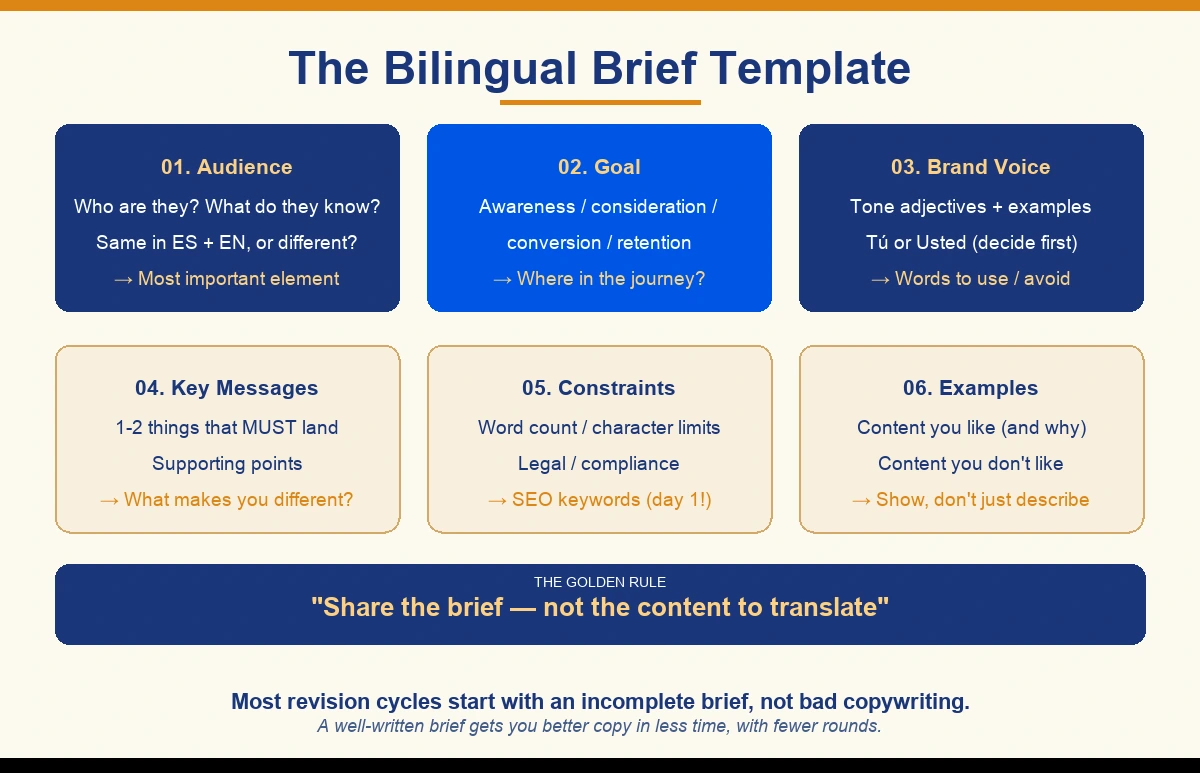
This is the structure used for new bilingual copywriting projects:
Project overview
- What is being created (homepage, email sequence, landing page, etc.)
- Primary language and secondary language
- Approximate scope and deadline
Audience
- Who are they (role, company type, location, market)
- What do they currently know or believe
- What concerns do they bring to this decision
- Is the Spanish audience profile the same as the English one?
Goal
- What should they do after reading
- Where does this content sit in the customer journey
- How will success be measured
Brand voice
- Adjectives that describe the desired tone
- Tú or usted for Spanish
- Words and phrases to use
- Words and phrases to avoid
- Examples of content we like and why
- Examples of content we do not like and why
Key messages
- The one or two most important things the content must communicate
- Supporting points
- What makes this offer or brand different from alternatives
Constraints
- Word count or character limits
- Legal or compliance requirements
- Technical requirements
- Competitor restrictions
Existing content
- Link to or attach any existing content on this topic
- Note: existing content is reference, not source for translation unless specifically requested
Common briefing mistakes that slow down projects
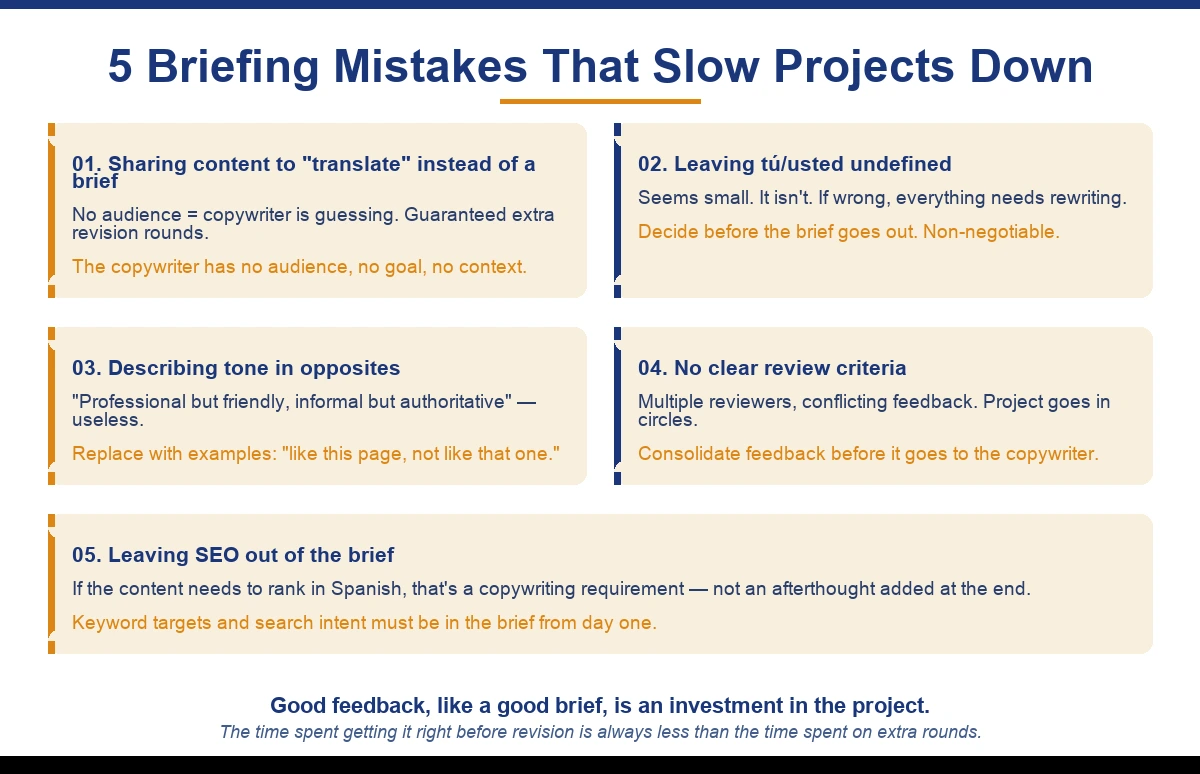
Sharing existing content to be translated rather than a brief. 🚩 This is the most frequent source of problems in bilingual copywriting projects.
When the brief consists of please translate this into Spanish, the copywriter has no information about the audience, the goal, the tone required, or what makes this content different from a straight translation project. The result is usually content that needs more revision than a properly briefed original would have.
Leaving the tú/usted decision undefined. This seems like a small thing. It is not. A copywriter who has to guess may well make the right call. But if it is wrong, everything needs rewriting. Make this decision before the brief goes out. It is non-negotiable.
Describing the tone in opposites. Professional but not stuffy, informal but not unprofessional, friendly but authoritative. This kind of description is almost universally present in briefs and almost universally unhelpful. Replace it with examples:
Like this brand page — not like that one.
That is worth a thousand adjectives. 📝
Setting up revision rounds without clear criteria. We will review the draft and send comments works if everyone who reviews the draft has the same frame of reference. It often does not. Establish before the project starts who reviews, what they are reviewing for, and how feedback is consolidated before it goes back to the copywriter.
Leaving SEO requirements out of the brief. If the content needs to rank in Spanish, that is a copywriting requirement, not an afterthought. Keyword targets, search intent and any existing keyword research should be in the brief from day one.
How to give useful feedback on bilingual copy
Feedback is one of the parts of bilingual content projects that most often goes wrong — largely because giving useful feedback on copy in a second language is genuinely difficult.
A few principles that help:
Be specific about what is not working. 🎯 This does not sound right is not actionable. This sentence feels too formal for the audience we described — can we try something closer to how a knowledgeable colleague would phrase it? is. The more specific the feedback, the faster the revision.
Separate personal preference from audience fit. It is entirely possible for copy to sound different from what you expected while still being correct for the audience. The question to ask is not does this sound like the copy I would write? but does this sound like something my Spanish target audience would respond well to?
Avoid translating feedback directly from English. If your instinct is to say in English we would say X, so say that in Spanish, the result will usually be a translation of an English phrase rather than a native Spanish one. Instead, describe the effect you want:
- This needs to feel more direct
- This needs to be warmer
- This needs to establish credibility earlier
Consolidate feedback before sending it. Multiple rounds of conflicting feedback from different reviewers are the most common cause of project delays. Agree internally on the comments before they go to the copywriter. 🤝
Good feedback, like a good brief, is an investment in the project. The time spent getting it right before the revision is always less than the time spent on additional revision rounds.
Want to receive more resources on bilingual copywriting and international marketing? The Copybara newsletter covers what works (and what doesn’t) for Spanish-market content. Subscribe here.