How to enter the Spanish market with the right messaging
Imagine a boardroom meeting at a mid-sized European tech company. A product manager has just come back from a conference in Madrid. The feedback? Great product. Real interest. But the numbers are not moving.
Someone on the marketing team suggests an answer:
It’s Spain. People speak Spanish. Let’s just adapt the content we already made for Mexico.
This is the moment where market entries go wrong. 🚩
Spain is the fourth-largest economy in the eurozone — 47 million people, high digital engagement, real spending power in the right demographics. But it has a well-established local culture that does not respond kindly to generic European marketing, and it is nothing like Latin America. Brands that arrive without understanding this tend to find that the numbers simply do not add up.
The problem is almost always the messaging.
- Spain is not just another Spanish-speaking market
- Cultural nuances that shape how Spanish consumers respond
- The most common mistakes international brands make
- The role of tone, formality and humour
- A brand that got it right and one that did not
- How to localise your content for Spain
Spain is not just another Spanish-speaking market
This is the first and most important thing to understand before entering Spain with a marketing budget.
Spanish is spoken by more than 500 million people across 20 countries. But Spanish in Madrid is not the same language as Spanish in Buenos Aires, Mexico City or Bogota. The vocabulary differs, the idioms differ, the relationship with formality differs significantly, and the cultural references that build trust and recognition are almost entirely distinct.
Brands that have succeeded in Latin American markets and assume the same content can be repurposed for Spain with minimal adjustment consistently underperform. It is not that the product is wrong. It is that the message feels slightly off — and in a competitive market, that is enough to push a potential customer toward a brand that feels more native.
Cultural nuances that shape how Spanish consumers respond
A few things that consistently catch international brands off guard:
Directness is valued, but warmth matters too. 🤝 Spanish consumers respond well to communication that is confident and clear. But a purely transactional tone lands badly. Relationships and personal trust carry more weight here than in, say, the German or Scandinavian markets. Copy that sounds like a contract will struggle to convert.
Humour is welcome, but it is locally specific. Spanish humour tends toward irony, understatement and self-deprecation. American-style positivity can feel hollow. British dry wit travels reasonably well. Latin American playfulness sometimes misses the mark entirely. If your brand uses humour, it needs recalibrating for the Spanish cultural register — not just translating.
Trust-building takes precedence over urgency. Scarcity tactics and aggressive sales language, which can work in other markets, often backfire in Spain. Spanish consumers are sceptical of hard-sell techniques and respond better to brands that demonstrate genuine expertise before asking for a commitment. 📉
Regional identity is part of the picture. Spain is a country of strong regional identities. Catalan, Basque, Galician and Andalusian consumers each bring their own cultural sensibilities. For most international brands at the market entry stage, targeting Spain-Spanish broadly is the right approach — but knowing the country is not monolithic helps avoid tone-deaf messaging.
The most common mistakes international brands make
Using Latin American Spanish for a Spanish audience. 🌎 This is the single most frequent and damaging error. To a Spanish reader, Latin American Spanish reads as foreign, regardless of whether the content is technically correct. Using vosotros properly, avoiding Latinamerican Anglicisms, and using vocabulary that reflects how people actually speak in Spain are non-negotiable for a brand that wants to feel local.
Translating without localising. Accurate translation produces text that can be read. Localisation produces text that feels native. The difference is in the idioms, the examples, the formality level and the cultural references. A translated homepage can be perfectly grammatical and still feel like it was written by someone who has never visited the country.
Being too formal, or not formal enough. The tú/usted distinction is one of the first decisions any copywriter makes for the Spanish market, and it has real consequences. Most B2C brands in Spain use tú. Many B2B brands in professional services still lean toward usted. Getting this wrong creates an immediate sense of misalignment between the brand and its audience.
Ignoring Spanish SEO. What Spanish-speaking people search for online is not simply the translation of what they search for in English. Keyword research needs to be conducted from scratch in Spanish, with a genuine understanding of search intent in the Spanish market.
The role of tone, formality and humour
The Spanish market sits at an interesting intersection: consumers appreciate professionalism and expertise, but they are also comfortable with informality and humour in commercial contexts where other markets might expect more distance.
A financial services brand, for instance, might use a tone in Spain that would feel too casual in Germany. A fashion brand might use irony in Spain that would feel risky in a more conservative market. The range is wider — but navigating it requires cultural familiarity, not just linguistic fluency.
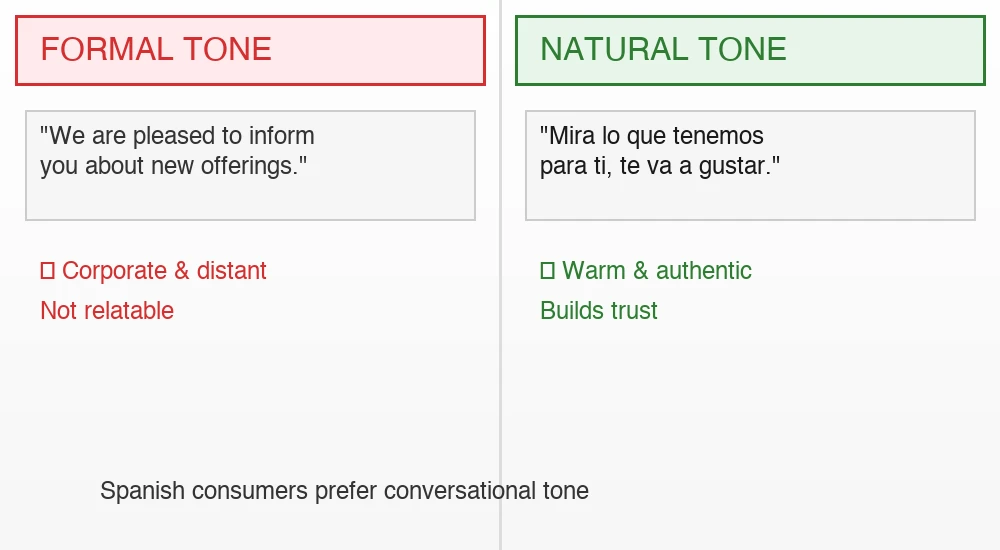
The key question to ask when reviewing your Spanish copy: does this sound like something a knowledgeable Spanish person would actually say to a friend or colleague? If the answer is no, the copy needs work.
A brand that got it right and one that did not
A well-known sportswear brand entering Spain in the early 2000s invested in genuine localisation. Rather than running translated versions of its global campaigns, it commissioned Spanish-specific content that featured local references, used Spanish humour in its social copy and calibrated its tone of voice to the specific register Spanish consumers were already using to talk about the category. Market share grew steadily in the first three years. 🚀
A different brand in the tech sector launched in Spain with copy translated directly from its English-language European campaigns. The product was well-received. The marketing performed noticeably below benchmark. Consumer research identified the same issue consistently:
The ads feel like they are not really for us.
The brand invested in a localisation programme twelve months later and saw measurable improvement in both brand recall and conversion.
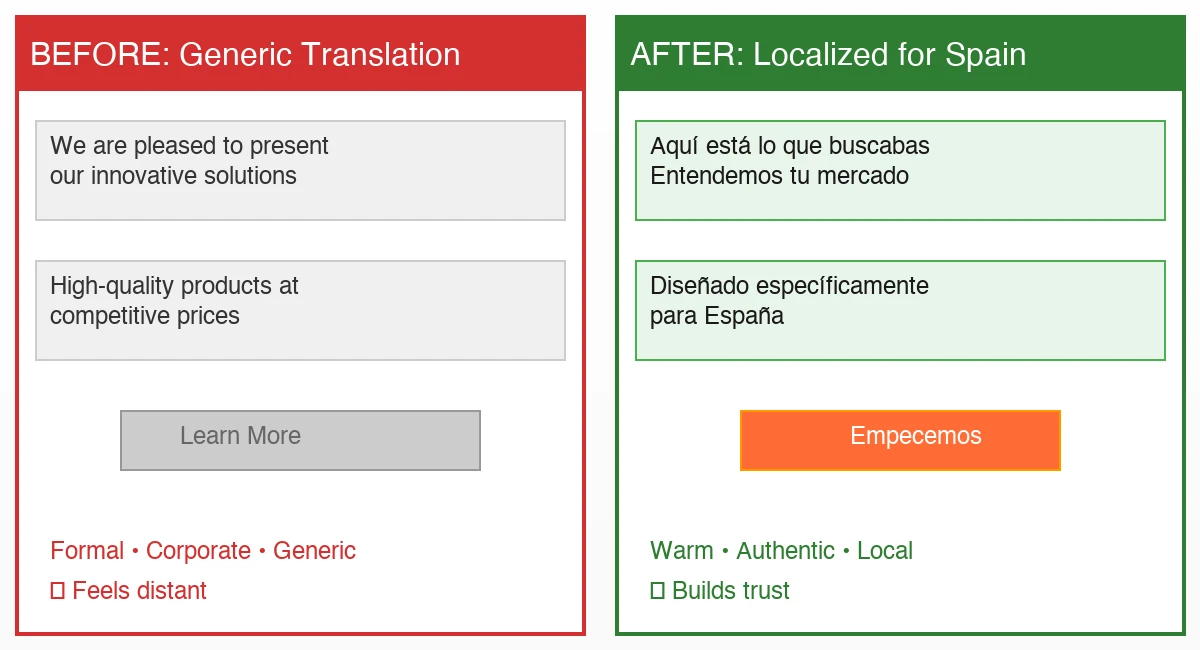
The product was not the problem in either case. The messaging was.
How to localise your content for Spain
Start with your most visible content: the homepage, the core services or product pages, and any advertising that will run in Spanish. For each piece, ask:
- Is this written in Spain Spanish, or in a neutral or Latin American variant?
- Does the tone match the register Spanish consumers use in this category?
- Are the cultural references recognisable and appropriate for a Spanish audience?
- Does the copy lead with the benefits and trust signals that matter to Spanish buyers specifically?
- Is the SEO based on Spanish-native keyword research, or on translated English keywords?
If you are uncertain about any of these, a communication audit is a low-risk way to get clear answers before committing to a larger content investment.
For a deeper look at the specific copy challenges involved in building a Spanish website, read our article on how to write a Spanish website that converts.