Why your Spanish marketing isn't working (and how to fix it)
You open the dashboard. You look at the numbers. You look at them again.
The Spanish campaign is running. The targeting is solid. The budget is the same as the UK campaign that delivered a 4% conversion rate. But the Spanish version is barely breaking 1%. 📉
Maybe Spaniards just don’t respond to digital marketing the same way.
They do. The problem is almost certainly the copy.
In the majority of cases where international brands underperform in Spain, the product is not the issue. The strategy is not the issue. The content is — and specifically, the content is failing for one or more of six identifiable, fixable reasons.

- The six most common reasons international brand content fails in Spain
- How to audit your current Spanish content
- Quick wins you can implement today
- When to bring in a professional
The six most common reasons international brand content fails in Spain
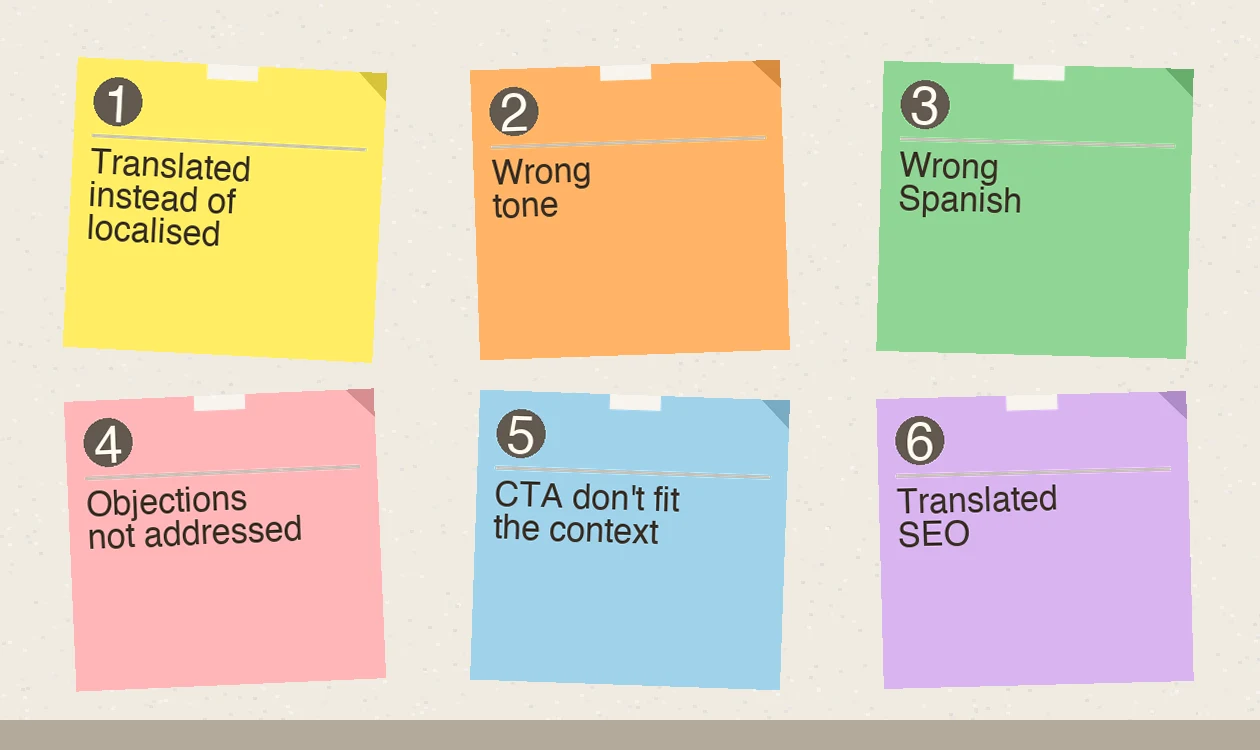
1. You translated instead of localised 🔄
The most frequent and most damaging issue. Translation and localisation are different processes. Translation produces a version of your content that is accurate in another language. Localisation produces a version that feels native to a specific audience in a specific cultural context.
A translated Spanish website is readable. A localised one is persuasive. The difference is in the idioms used, the examples chosen, the tone calibrated to the specific expectations of Spanish consumers and the way trust is built within the copy itself.
If your Spanish content was produced by translating your English content, it is almost certainly underperforming for this reason — even if it reads correctly.
2. Your tone is wrong for the context 🎭
Spain has specific norms around commercial communication. These differ from German norms, British norms, American norms and Latin American norms. Getting the tone right is not a stylistic preference; it affects whether readers trust the brand enough to take action.
The most common tonal errors: being too formal (corporate language that feels cold and impersonal), being too informal in categories where authority is expected, and being too aggressive in sales register — a style that Spanish consumers associate with brands that do not respect their intelligence.
3. You are using the wrong Spanish 🇪🇸
Spain Spanish and Latin American Spanish are not interchangeable. This is not a minor regional variation like the difference between British and American English. The vocabulary, idioms, formality conventions and cultural references can differ significantly. Using Latin American Spanish for a Spanish audience signals clearly that the brand has not made the effort to show up properly.
A Spanish reader will notice immediately if the copy uses vos instead of tú, if it uses Latin American colloquialisms not used in Spain, or if it avoids the vosotros form entirely. Small things individually. Together they create a persistent sense that the brand is not really addressing them. 👀
4. Your copy does not address Spanish-specific objections 🤔
Every market has its own decision-making patterns and its own objections. Spanish consumers tend to place high value on knowing who they are dealing with. They want to understand the person or team behind the brand before they commit. They respond well to specific, concrete evidence rather than general claims. And they are particularly attentive to whether a brand genuinely understands Spain — or is simply showing up with a globalised offer and assuming it will land.
Copy that does not address these specific expectations will consistently underperform against copy that does.
5. Your calls to action do not fit the context 📣
Submit translated as Enviar is technically correct and feels impersonal. Cuéntame tu proyecto (tell me about your project) or Hablamos (let’s talk) creates an invitation rather than a form completion.
The specific phrasing matters enormously for conversion, and the effective phrasing in Spanish is rarely the translation of whatever worked in English.
6. Your SEO is built on translated keywords 🔍
Spanish search behaviour is not a translation of English search behaviour. The terms people use, the questions they ask and the intent behind searches can differ significantly between the two languages.
A Spanish website built on keywords derived from translating English search terms will miss large portions of available organic traffic. Native-language keyword research, done with genuine knowledge of the Spanish market, is a different process from translating an existing keyword strategy.
How to audit your current Spanish content
An effective content audit does not require an expensive agency engagement. A structured review of your most important content will surface most of the issues.
Start with your homepage, your top service or product pages, and any content that is directly linked to conversion. For each piece:
Read it aloud in Spanish. Content that sounds wrong when spoken is almost certainly wrong in writing too. Pay attention to any phrases that make you stumble or feel slightly awkward.
Have it reviewed by a native Spanish speaker from Spain — not from Latin America. Ask them specifically: does this feel like it was written for you, or for someone else?
Compare your tone to competitors performing well in the Spanish market. Where does your content sit relative to theirs? Is it warmer, colder, more formal, less specific?
Check your keyword data. Are you ranking for terms that Spanish people actually search for, or terms derived from your English strategy?
The audit will not always produce a single clear answer. But it will tell you whether the problem is in the translation, the localisation, the tone, the SEO or some combination. That clarity is what enables targeted improvement. 🎯
Quick wins you can implement today

Some improvements do not require a full content rewrite.
Audit and fix the tú/usted consistency. ✅ Mixed register within a page or sequence is immediately noticeable and easily fixed. Choose one and apply it throughout.
Replace generic claims with specific evidence. We work with leading brands is forgettable. We have worked with X, Y and Z on Spanish market entry is credible. Where you have specific, true information, use it.
Rewrite your calls to action. Look at every button, every form and every link text in your Spanish content. Ask whether the phrasing creates an invitation or just labels an action. Rewrite the ones that feel mechanical.
Review your subject lines and email preview text. These are often written quickly and rarely localised properly. A small improvement in Spanish email subject lines can produce meaningful improvements in open rates within weeks.
Update cultural references. Any examples or analogies that are specifically Anglo-American in their cultural context should be replaced with ones that a Spanish reader will immediately recognise.
When to bring in a professional
Self-review and quick fixes address the most obvious issues. But if the underlying problem is that your content was translated rather than written for Spain, the most efficient solution is often to have the most important pages rewritten rather than patched.
The pages most worth investing in are those with the most direct relationship to revenue: the homepage, the core services or product pages, and the content driving your paid campaigns. Getting these right has an immediate and measurable impact on results.
A communication audit is a useful starting point if you are not sure where to focus. It identifies specifically which content is underperforming and why, and gives you a prioritised list of what to address.
For the broader picture of why Spanish marketing strategy requires more than translation, see our articles on bilingual copywriting and entering the Spanish market.