Transcreation examples: 5 campaigns that got it right (and 3 that didn't)
There is a fine line between a campaign that travels and one that arrives with its impact already lost in the journey.
Here is what that line looks like in practice:
A global bank launches a campaign that runs successfully in English-speaking markets for years. When they roll it out internationally, they hand it to local translation agencies. In several markets, the tagline ends up communicating the opposite of the intended message. The campaign is retired. The rebrand costs an estimated $10 million.
We’ll come back to that example. But first — what transcreation done well actually looks like. 🎯
- Five transcreation success stories with analysis
- Three campaigns that failed due to poor localisation
- What made the difference: process, expertise and cultural insight
- Lessons your brand can apply
Five transcreation success stories with analysis
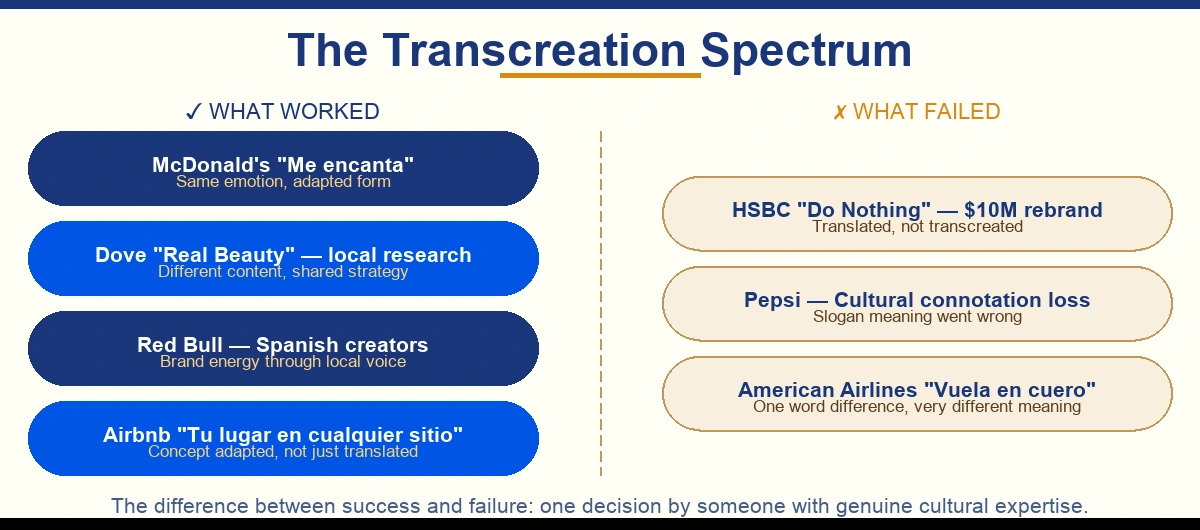
1. McDonald’s — “I’m Lovin’ It” ✅
One of the most globally consistent campaigns in advertising history, I’m Lovin’ It required significant transcreation work in every market.
In Spain, the Spanish-language version Me encanta preserves the emotional simplicity and directness of the original while feeling completely natural in Spanish. The jingle adapted as well — maintaining the rhythm and energy of the original without trying to replicate it exactly.
What made it work: The consistency across markets was achieved not by translating the tagline once but by commissioning each market’s version as an independent creative exercise, all working from the same brief. The brief said: here’s the feeling. You figure out the words.
2. Dove — “Real Beauty” ✅
Dove’s Real Beauty campaign required deep cultural research in each market it entered. The definition of beauty, the societal pressures around appearance and the emotional language around self-image differ significantly between the UK, Spain, Mexico and the United States.
The campaign succeeded because it did not use a single transcreated message globally. Instead, it used a shared strategic framework and allowed each market to develop content that addressed real beauty through local eyes.
The result was a campaign that felt personal in every market it ran in.
3. Red Bull — Spanish market entry ✅
Red Bull entered Spain with a clear understanding that its irreverent, Gen Y humour would need recalibration. British and American irony do not always travel well to Spain. 🇪🇸
The brand invested in Spanish creators and Spanish-native copywriters to develop content that maintained the brand’s energy and edge — but expressed it through Spanish cultural references, Spanish humour and Spanish vernacular.
The brand’s voice in Spain feels authentically Spanish while remaining recognisably Red Bull. That is the transcreation ideal.
4. Netflix — Spanish original and dubbed content ✅
Netflix’s approach to Spanish-language content is instructive for any brand working in transcreation. The platform distinguishes carefully between Spain Spanish and Latin American Spanish — not just in subtitles but in dubbed content, marketing campaigns and even email communications.
The investment in market-specific content has contributed significantly to Netflix’s dominance in Spanish-language streaming, where competitors who took a more neutral approach have consistently underperformed.
5. Airbnb — “Belong Anywhere” ✅
Belong Anywhere is a concept that required careful transcreation in Spain, where the notion of belonging has specific cultural weight related to community, neighbourhood identity and the particular Spanish relationship with place.
The Spanish campaign developed around these specifically local ideas of belonging, using imagery, copy and stories that were recognisably Spanish rather than globalised. The core emotional proposition was the same as in every other market. The vehicle was built for Spain.
Three campaigns that failed due to poor localisation
1. HSBC — “Assume Nothing” ❌
This is probably the most widely cited transcreation failure in marketing.
HSBC’s Assume Nothing campaign ran successfully in English-speaking markets for several years before being rolled out internationally. In several non-English markets, the campaign was handled by local agencies that translated rather than transcreated the tagline.
In multiple languages it ended up communicating something closer to Do Nothing — which is not only off-message but actively harmful for a financial services brand.
The campaign was retired and the bank spent an estimated $10 million rebranding to “The World’s Local Bank.” A native speaker review before launch would have cost a fraction of that. 😬
2. Pepsi — “Come Alive with Pepsi” ❌
In the 1960s, Pepsi’s Come Alive with Pepsi slogan was reportedly translated in some markets in ways that produced meanings along the lines of Pepsi brings your ancestors back from the dead.
While the specific details of this story have been somewhat embellished over the years in marketing folklore, the underlying dynamic is real: slogans that depend on culturally specific connotations for their effect are particularly vulnerable to transcreation failure.
3. American Airlines — “Fly in Leather” ❌
American Airlines launched a promotion for leather seat upgrades in Mexico with Vuela en cuero — which does mean “fly in leather” in Spanish.
Unfortunately, en cueros (slightly different but easily confused in spoken language) is a common idiom for stark naked. 🙈
The campaign generated significant unintended amusement among Mexican consumers before being revised.
The lesson is not that Spanish translation is difficult. It is that the difference between successful transcreation and an embarrassing error often comes down to a single decision by someone with genuine cultural and linguistic expertise.
What made the difference: process, expertise and cultural insight
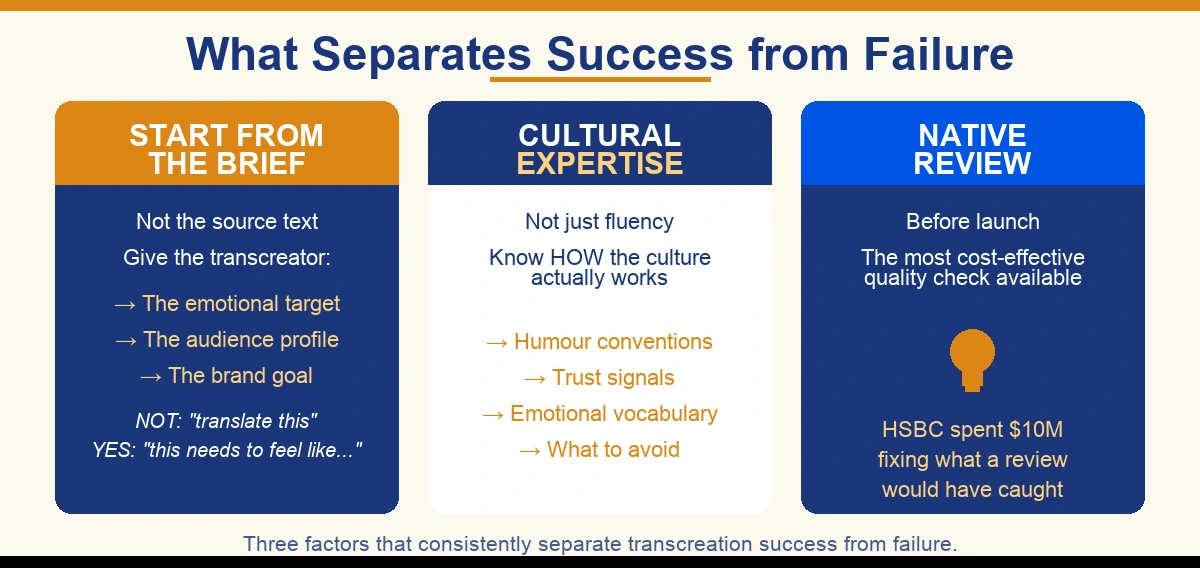
Looking across successful and unsuccessful examples, three factors consistently separate the two outcomes.
Starting from the brief, not the source text. 🎯 Brands that treat transcreation as a creative brief rather than a translation assignment consistently produce better results. The brief says: here is the emotional impact this needs to have, here is the audience it needs to reach. The transcreator then builds the best version of that in the target language, without being constrained by the source text.
Hiring for cultural knowledge alongside linguistic skill. The most damaging failures typically involve translators who are linguistically qualified but lack deep knowledge of how the target culture actually works. Transcreation requires someone who can write persuasively in the target language AND understands the cultural context well enough to know what will land and what will not.
Building in review by the target audience. The most costly failures could have been caught at minimal expense by asking native speakers from the target market to review the work before launch. This is not optional in transcreation; it is part of the quality process. 🔍
Lessons your brand can apply
If you are planning to transcreate content for the Spanish market, the practical takeaways from these examples are:
Brief the project as a creative assignment, not a translation task. Give the transcreator the emotional target and the audience — not just the source text.
Hire someone with cultural expertise in Spain specifically, not just Spanish-language competence. The specific cultural knowledge matters enormously.
Build in native speaker review before launch. This is the single most cost-effective quality control step available.
Expect the transcreated version to differ from the original. If it is identical to a word-for-word translation, it probably has not been transcreated. 💡
For more on what the transcreation process looks like in practice, see the Copybara transcreation service.
Want to stay up to date on transcreation, localisation and bilingual copywriting? The Copybara newsletter shares real examples and practical analysis. Subscribe here.